Stay Connected


Stay Connected


Terms of Use
Privacy Policy
Cookie Notice
Ant Group
© 2026, Ant International or its affiliates.



On 16 June 2025, Ant International released its inaugural sustainability report. In this blog, Chief Sustainability Officer Chen Leiming and Head of Global Affairs and Strategic Development Carrie Suen share how the company is driving inclusive growth through its newly launched sustainability framework.

Author 1: Leiming Chen, Chief Sustainability Officer, Ant International

Author 2: Carrie Suen, Head of Global Affairs and Strategic Development, Ant International
1. What are some of the most notable trends and challenges for sustainability work in the fintech industry?
The need to champion financial inclusion is stronger than ever, amid geopolitical uncertainty and global trade challenges.
Sustainability must be inclusive to be effective. Globally, SMEs make up over 90% of all companies, but they are especially vulnerable to economic and trade uncertainties due to a lack of the resources required to adapt to economic changes.
Thus, collective effort across public and private sectors is required to ensure that no SME is left behind. We should empower SMEs in the context of re-globalisation and help them become more resilient in these uncertain times. There is a need to ensure that SMEs also have access to such technologies, as fintech and AI will play an increasingly critical role in driving global prosperity.
2. What are the basic principles that guide Ant International’s sustainability strategy?
We focus on a 6T sustainability strategy - Travel, Trade, Thrive, Technology, Talent and Trust – to build real-world impact.
This means that we enable global connections through Travel while empowering global commerce through Trade. We foster inclusive growth through Technology innovation and provide accessible lending and credit tech tools to help the underserved Thrive.
We also empower sustainable digital transformation through Talent development, as well as low-carbon operations and collaborations with partners. We believe in innovating responsibly though open collaborations to build Trust in the ecosystem of digital payment and financial services.
3. What are the 3 most important things of your sustainability work?
Firstly, it is important for us to drive mindshare internally and make sustainability key in our corporate culture so that we can drive momentum from the bottom up.
Secondly, we are constantly seeking to better understand the evolving needs of our external stakeholders to provide solutions that not only address their needs but also promotes sustainability and inclusion.
Finally, we need to ensure that there is a robust governance framework to instil accountability and transparency in our sustainability efforts.
4. How are your sustainability approaches and practices differentiated from other players in the field?
For Ant International, sustainability is integrated into our business model from day one, as per our mission “to make it easy to do business anywhere, bringing small and beautiful changes to the world”. We follow a dual-value approach, where business value and sustainability value reinforce each other, and we front-load SMEs in our business decisions.
The world’s problems are too big for any one individual or company to solve alone. We are a big believer in open collaborations and partnerships, which are key to our progress.
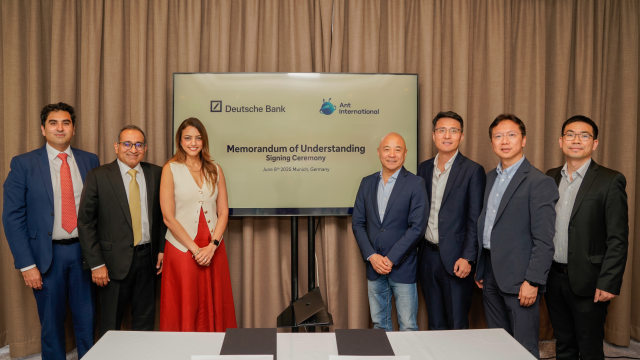
We’ve established partnerships with both public and private stakeholders, engaging them in various collaborations from digital upskilling programs to joint AI research initiatives. In Singapore, where we are headquartered, we work with the Nanyang Technological University on privacy-enhancing technologies.
5. What are the challenges of implementing that strategy in a start-up with limited resources?
Sustainability requires collective effort. We need to build an open ecosystem because there are never enough resources for sustainability – by working with partners, it contributes to a democratisation of resources.
One example is Programme SIRIUS (Sustainable Innovation for Regenerative and Inclusive Purpose) of which Ant International is a partner. We have collaborated with Gprnt, an initiative by the Monetary Authority of Singapore, to provide a tech-enabled reporting solution for MSMEs to make simplified sustainability disclosures against basic ESG metrics. This in turn gives them better access to green financing options.
Another challenge is ensuring that our internal business and stakeholders are bought into these initiatives. We need to get them to see the long-term business value and returns that come with investing in sustainability, and this is an ongoing process.
Finally, sustainability is still very much a developing field. It’s important for us to learn from our peers who are driving their own sustainability efforts and incorporate those learnings to address stakeholder needs.
6. How do you incentivise internal stakeholders to ensure sustained employee and management endorsement and participation in your sustainability programs?
As with any sustainability initiatives, transparency is important to help internal stakeholders to understand where we are driving impact. It is easy to become overly-focused on business solutions and results, while overlooking the social and environmental impact that is generated.
Improving engagement is also key, via workshops and trainings rather than merely top-down direction. Internally, we have launched a sustainability ambassador programme to engage employees who are interested in helping advance our sustainability efforts and who can help implement initiatives locally.
7. How do you coordinate global sustainability work with Ant Group?
Ant Group launched its ESG strategic framework four years ago, encompassing its international business as part of its sustainability efforts. We learned a lot in the process, which helped us formulate our current sustainability framework.
Since Ant International is an independent company, we now have our own sustainability strategies. Ant International focuses more on merchants and businesses, so our focus is primarily to empower our partners to have autonomy and participation in joint sustainability efforts. However, there is also collaboration with Ant Group in areas of common interest.
8. What are your sustainability goals in 3 years?
We want to be a leading company that is recognised for our sustainability efforts in driving digital economy development and inclusive growth for global SMEs. Ultimately our goal is to help businesses grow sustainably, as stated in our vision to “be the most innovative and trusted digital partner to bring inclusive growth to all.”
Some indicators that we see as good progress include expanding connectivity for more merchants and SMEs to global travel and trade, and leveraging AI innovations to help businesses reduce costs, enhance transaction security and improve efficiency in cross-border payments, treasury management, and financial services. We also hope to build a growing ecosystem of partners to advance sustainability initiatives.